

Future skills for advanced welding automation
Preparing the workforce to deliver resilient and high integrity infrastructure
As the UK accelerates towards its clean energy and defence ambitions, the delivery of large-scale infrastructure will depend not only on advanced technologies, but also on the ability to manufacture, maintain and sustain critical assets at pace and quality.
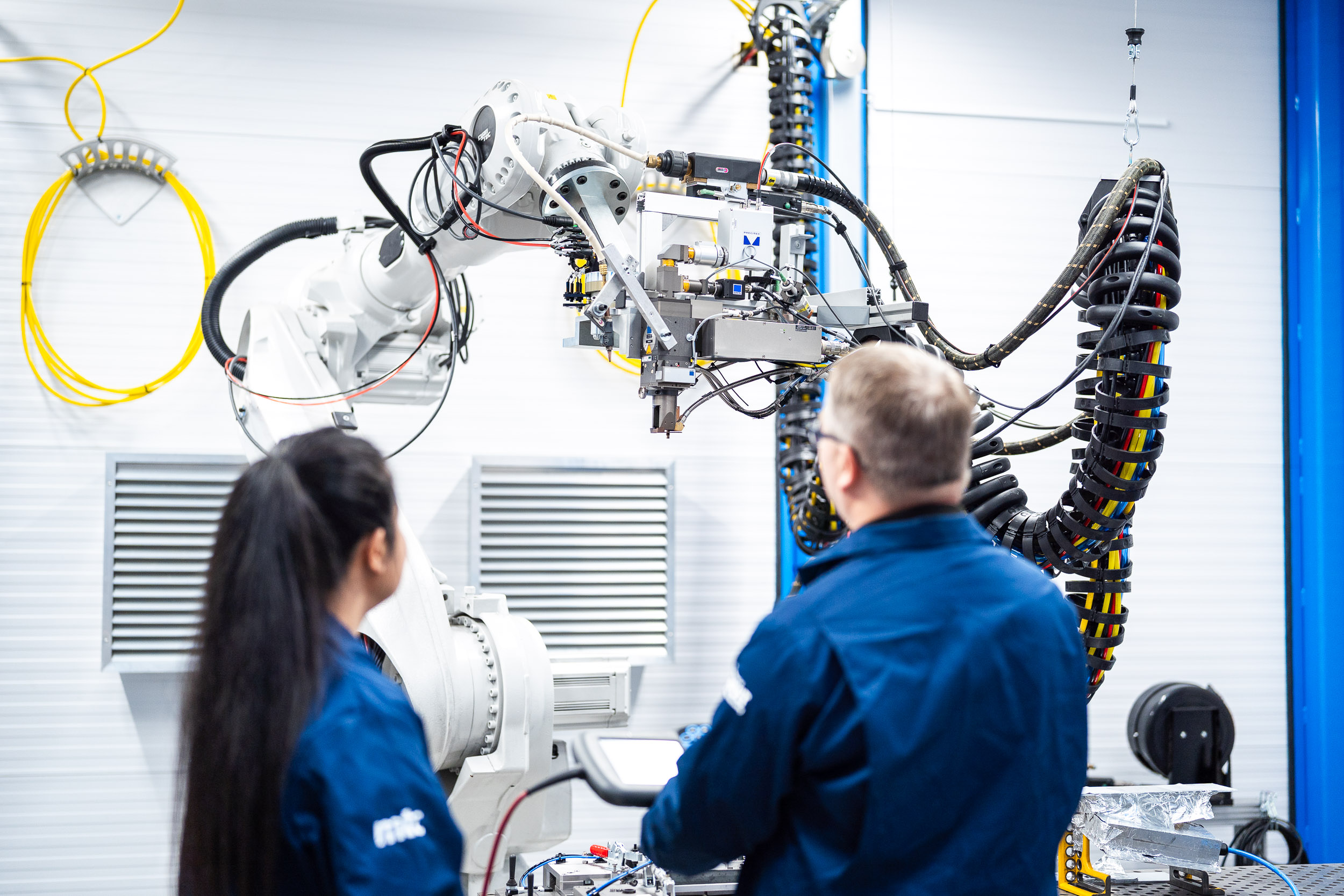
Welding sits at the heart of this challenge. However, meeting future demand is not just about increasing welding capacity—it is about transforming how welding is delivered, moving from manual processes to intelligent, automated, and digitally integrated systems.
This report sets out the findings of a Workforce Foresighting cycle focused on Advanced Welding Automation and explores the future skills required to deploy robotics, AI, machine vision and in-line inspection to ensure production continuity in high integrity sectors.
The study was led by the Manufacturing Technology Centre (MTC), in partnership with the Workforce Foresighting Hub, an Innovate UK programme.
Why workforce foresighting matters
Workforce foresighting is a systemic approach that enables industry, educators and policymakers to anticipate how emerging technologies will reshape workforce demand.
By identifying future capability requirements early, it allows education and training systems to adapt in time—moving skills provision from a reactive to a proactive footing, and ensuring the UK has the workforce needed to adopt and scale new technologies.
In this study, foresighting has been applied to a critical national challenge: how to secure the future of welding and fabrication capability in the face of rising demand and a declining workforce.
Strategic context
The UK is entering a period of unprecedented infrastructure demand across defence, energy and advanced manufacturing. At the same time, the welding workforce faces significant demographic pressures, with high retirement rates expected to reduce available capacity.
This creates a structural risk: without intervention, shortages in skilled labour will constrain delivery timelines, increase costs, and impact the resilience of critical national infrastructure.
Traditional manual welding approaches alone cannot meet future requirements. Instead, a new generation of technologies is emerging, including:
- Robotic welding and automation
- AI-driven process control and optimisation
- Machine vision and advanced sensing
- In-line volumetric inspection and digital quality assurance
Together, these technologies represent a shift from manual fabrication to digitally integrated, adaptive and automated production systems, enabling higher quality, traceability and productivity.
Implications for the workforce
Workforce capability as the critical enabler
The transition to advanced welding automation is constrained less by technology availability than by workforce capability to adopt and deploy it effectively. The study highlights a broad and evolving set of organisational capabilities required to enable this shift, spanning robotics and automation integration, digital systems and data architectures, AI-enabled monitoring and control, cyber security, and system optimisation.
These capabilities reflect a move away from traditional, siloed skillsets towards a more integrated and technologically advanced workforce. However, the central challenge is not simply to train more welders or more automation engineers. Instead, it is to bridge the divide between these disciplines, enabling hybrid roles that combine deep process knowledge with digital, data and automation expertise.
Shift towards integrated, system-level capability
The analysis identifies a set of priority capability areas that are fundamental to the successful adoption of advanced welding automation. These include real-time sensing and monitoring, robotic welding combined with in-line inspection, simulation and commissioning, system integration, and cyber security embedded by design.
Taken together, these themes point to a broader transformation in how welding systems are designed and operated. Future capability will increasingly be defined by the ability to manage end-to-end, data-driven systems, where design, operation, quality assurance and safety are fully integrated. This represents a shift from task-based skills towards holistic, system-level thinking, where interoperability, real-time data and resilience are embedded across the lifecycle.
Transformation of roles, not creation of new ones
The workforce implications of this transition are characterised less by the emergence of entirely new job roles, and more by the evolution of existing ones. The study identifies a set of Future Occupational Profiles spanning engineering, digital, data and strategic leadership functions, reflecting the convergence of manufacturing and advanced digital systems.
Roles such as robotics engineers, industrial engineers, digital systems architects and PLC engineers will become central to delivery, alongside cyber security and strategic leadership roles that enable system-wide integration and adoption. These roles will increasingly require individuals to operate across traditional boundaries, combining expertise in manufacturing processes with capabilities in digital systems, data and automation.
As a result, the future workforce will be defined by its ability to translate advanced technologies into practical, scalable and secure industrial applications.
Structural skills gaps and system constraints
A significant barrier to progress is in the current misalignment between emerging capability requirements and existing education and training provision. The study highlights structural gaps in the skills system, including limited integration between welding and automation pathways, fragmented and informal approaches to upskilling, and low alignment between new capability needs and established standards.
Access to specialist infrastructure and training environments also remains limited, further constraining the ability to build capability at scale. These challenges have contributed to a pronounced hybrid skills gap, where welders lack the digital and systems integration skills required for automated environments, and automation engineers lack the foundational welding and materials knowledge necessary to operate effectively in high-integrity applications.
The key implication is that the UK’s ability to deliver critical defence and energy infrastructure will depend as much on workforce capability as on technology adoption. Without rapid investment in hybrid skills, structured training pathways and cross-disciplinary capability development, advanced welding automation will not scale at the pace required—creating a bottleneck in production, increasing costs, and weakening sovereign capability.
Addressing this requires coordinated, system-wide action to evolve roles, align education provision, and build a workforce capable of delivering digitally integrated, high-integrity manufacturing at scale.
Next steps
The report identifies priority actions to address these challenges and enable workforce readiness:
- Establishing a welding-first, automation-second capability pipeline
- Developing modular CPD pathways to support two-way upskilling
- Enhancing existing apprenticeship standards with automation and digital content
- Creating a national welding automation hub to support capability development
- Strengthening collaboration across industry, education and government
These actions aim to move from fragmented, ad hoc skills development towards a coordinated, scalable workforce system aligned to future demand.
Related programme

Workforce Foresighting
How do we build a skilled workforce for tomorrow’s industries? The Workforce Foresighting Hub has developed a structured process, aligned with national policy, to help deliver a workforce to exploit innovative technologies in the UK. We’re supporting industry, policymakers and educators to adapt to continuing change.