
Brains beat brawn: how insect intelligence could reshape future autonomous systems
Forget bigger datasets and ever-more powerful computers. The next breakthrough in autonomous robotics could come from the tiny brain of a desert ant. Discover how nature’s extraordinary approach to navigation is inspiring a new generation of intelligent machines.
A groundbreaking research project supported through UK Research and Innovation’s (UKRI) Future Leaders Fellowships (FLF) programme is challenging conventional thinking about artificial intelligence by looking to one of nature’s smallest navigators for answers.
Supported through the programme’s business strand, delivered by Innovate UK, Dr Michael Mangan is exploring how the remarkable navigation abilities of desert ants could inspire a new generation of autonomous technology. As Vice President of Research at Opteran and Senior Lecturer in Machine Learning and Robotics at the University of Sheffield, Dr Mangan is investigating how insect brains achieve remarkable navigation capabilities using very little computing power.
Through Opteran, a University of Sheffield spinout, insights from this research are being translated into commercial technology designed to help robots operate more efficiently and autonomously in complex, challenging environments.
The team’s latest research has developed a method to reconstruct what individual desert ants see as they explore their surroundings, creating new opportunities to understand how sensory information shapes their behaviour and how those principles can be applied to the next generation of autonomous machines.
Rethinking autonomy
Today’s AI and autonomous systems often rely on vast quantities of data, intensive computing power and, in many cases, connectivity to cloud-based services or satellite infrastructure. As these technologies become more sophisticated, so do their energy and resource requirements.
Nature offers a different approach.
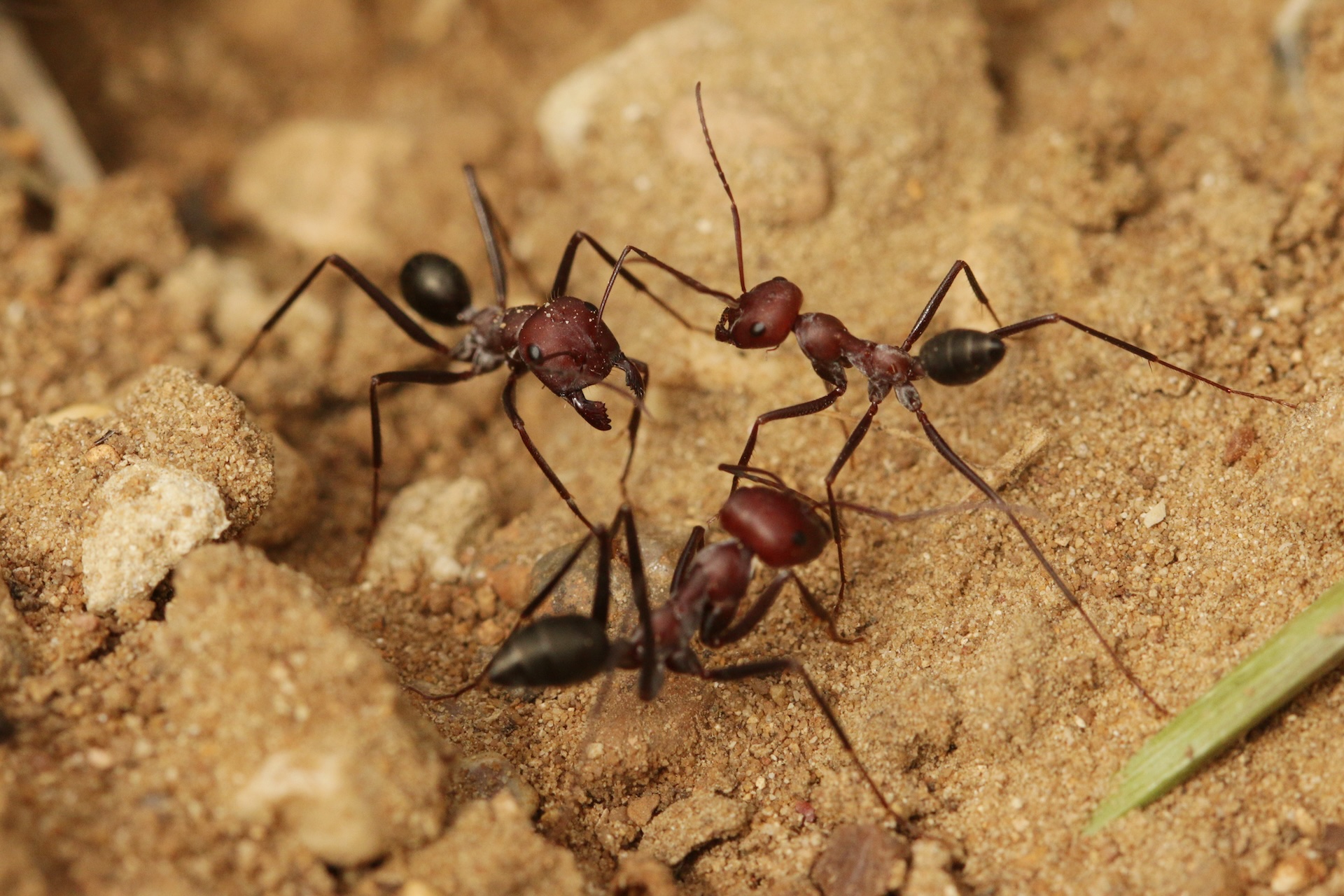
Desert ants routinely travel hundreds of metres across challenging terrain, navigating changing surroundings and finding their way back to their nests using brains no larger than a pinhead. They do this without GPS, communications networks or the computing resources associated with modern autonomous systems.
Dr Mangan’s research explores how evolution has equipped these insects with such effective navigation abilities, and whether understanding these biological solutions could help develop more efficient, adaptable and reliable autonomous technologies.
The commercial potential is significant. Robots that can navigate and make decisions with less computational power and reduced reliance on external infrastructure could operate more effectively in demanding real-world environments.
Seeing the world through an ant’s eyes
One of the biggest challenges in understanding insect intelligence is discovering what information is available to an insect’s brain as it moves through the world.
Although researchers have spent years studying insect neutral circuits and behaviour, accurately recreating their visual experiences has remained difficult. Traditional computer models often rely on simplified panoramic images do not fully reflect how compound eyes capture visual information.
This latest research addresses this challenge by bringing together detailed behavioural tracking, environmental mapping, and sophisticated computer modelling. Using tracking data from desert ants in southern Spain, a detailed 3D reconstruction of their natural habitat, created from 56 laser scans, and high-resolution imaging of an ant’s compound eye, the researchers developed a method to create the visual information available to individual ants as they navigate their surroundings.
The resulting simulations reveal a world quite different from our own, with blind spots, uneven visual sampling, and complex field of view. For the first time, researchers can reconstruct the visual histories of individual desert ants as they explore their natural habitat, providing a more realistic picture of the information available to their brains during navigation. This offers an important new opportunity to investigate how insects process sensory information, learn from their surroundings, and adapt their behaviour.
Benefits for science and industry
The research opens commercial possibilities across several disciplines, particularly neuroscience, robotics and engineering. For neuroscientists, reconstructing an insect’s visual experience provides valuable data for developing and testing models of brain function. Researchers can compare computational model predictions with observed animal behaviour, helping them better understand the mechanisms behind navigation.
For robotics and engineering, the findings could help address a different challenge: developing autonomous machines capable of navigating reliably without continually increasing their computational requirements.
This is where Opteran comes in.
The company is developing insect-inspired ‘Natural Intelligence’ software, translating insights from nature into technology for autonomous machines. As Vice President of Research, Dr Mangan helps bridge biological research and its practical application in robotics. Rather than attempting to replicate increasingly large AI models, this approach looks to reverse-engineering the highly efficient algorithms that allow animals to perceive, navigate, and adapt to complex environments, and translate them into software that robots can use.
The result is a powerful example of how curiosity-driven research can create a pathway to commercial innovation, with fundamental questions about how a desert ant sees and navigates the world helping inform technologies designed to enable autonomous machines to do the same.
Bridging academia and industry
The project demonstrates the value of connecting academic research with commercial expertise, supported through the Future Leaders Fellowships programme. Dr Mangan’s dual roles at the University of Sheffield and Opteran place him directly at that interface, helping ensure that new scientific understanding can inform the development of commercially relevant, biometric technology. It is this ability to bridge discovery and application that makes long-term support for researcher-innovators particularly valuable.
The Future Leaders Fellowships programme supports talented researchers and innovators to pursue ambitious ideas while developing careers that can span academia and business.
Dr Mangan commented, “The Future Leader Fellowship was vital in enabling this research as it uniquely supports high-risk long-term industrial research where the return on investment can be far into the future. Moreover, by facilitating career changes – in my case, from academia to industry – the program is creating a new generation of UK-based academic-entrepreneurs able to both develop and deploy solutions to societies most pressing needs.”
Nature-inspired innovation
As industries explore the future of AI and robotics, this research demonstrates that innovation isn’t always about greater complexity or computational power. Sometimes, the most promising ideas come from understanding solutions that nature has refined over millions of years.
By reconstructing the world through the eyes of desert ants, Dr Mangan and his team are giving researchers new ways to understand how tiny brains produce remarkably complex behaviour. Through Opteran, these insights are helping inform a different approach to autonomous technology, drawing on the efficiency and adaptability of natural intelligence.
Dr Mangan’s work also demonstrated how Future Leaders Fellowships, supported by Innovate UK, can help turn pioneering research into technologies with real-world commercial potential.
When it comes to navigating a complex world, even the smallest brains have some big lessons to teach us.
Find out more
To learn more about the research and explore the findings in detail, read the full academic paper: What do navigating animals see? Reconstructing the visual histories of desert ants.
Related news
20 October 2026
Meet the Future Leaders Fellowships innovators shaping what comes next
Innovate UK is welcoming a new cohort of business fellows to the UKRI Future Leaders Fellowships (FLF) programme, supporting ambitious innovators to develop bold ideas with the potential to create lasting impact.
Read more
Related content