

Founded in 2022, Planarific is a spin-out from the University of Cambridge developing a spatial intelligence platform for the built environment that makes retrofit planning faster and more energy-efficient. It uses computer vision and AI to process information captured by drones and collected by users, and convert point clouds into high-fidelity, semantically enriched 3D models of buildings.
The UK has set a target of reaching net zero carbon emissions by 2050, requiring a major reduction in energy use and emissions from buildings. Upgrading existing housing stock to become more energy efficient is a significant challenge, with research showing that over half of UK homes currently score D or lower in EPC ratings. Currently, retrofitting is a slow and expensive process, with inspections and assessments requiring multiple site visits and bespoke designs. AI technologies have the potential to transform this process and accelerate the UK’s path to net zero.
Solution
Planarific joined the Innovate UK BridgeAI High Growth Accelerator programme, delivered by Digital Catapult, with a focus on early prototyping, refining its product concept, and testing the value proposition with industry partners to inform the development of scalable and responsible AI solutions for industrialised construction.
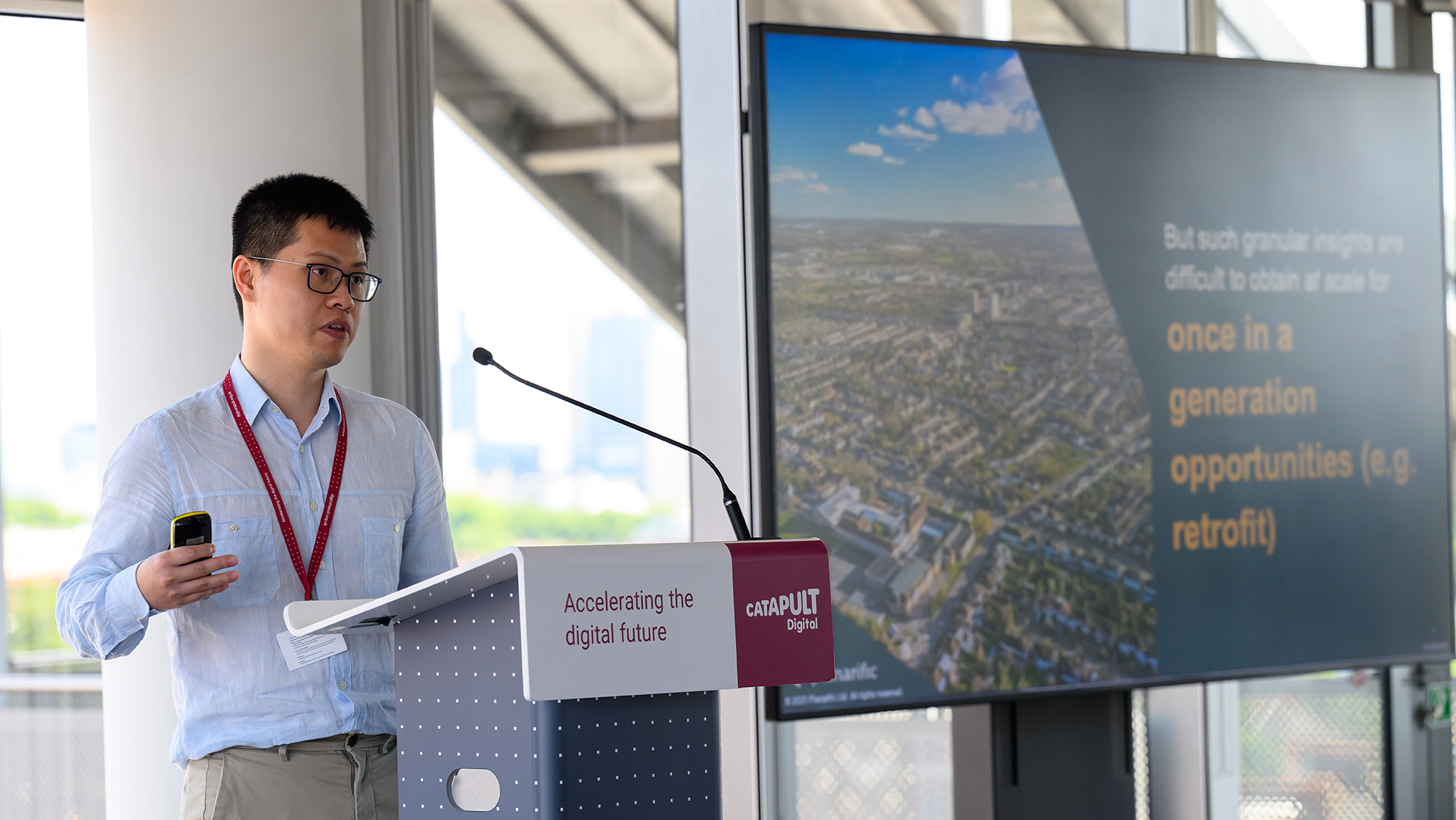
Accelerator support enables scaling
When Planarific joined the accelerator, the business was in its early stages and had not yet launched commercially. The team wanted to explore potential applications for their solution and test their hypothesis that Planarific models and data could plug into use cases in planning, energy modelling, maintenance and more.
The collaboration with Digital Catapult technical experts and industry specialists gave the Planarific team access to impartial advice, industry validation, responsible AI knowledge, and networking opportunities that supported the advancement of their retrofit solution. Planarific worked directly with retrofit industry experts and challenge owners, Buro Happold, and took part in expert-led workshops on responsible AI, business and innovation.
Digital Catapult’s support was instrumental in helping us move from concept validation to real-world application. We were keen to open up new collaborations and partnerships, and to meet others tackling similar problems from different angles. Working in partnership with Buro Happold challenged our thinking, strengthened our technical and commercial approach, and connected us with partners who genuinely understand the complexity of delivering innovation at scale.
– Ran Xiao, CEO & Founder, Planarific
Planarific’s building models provide quantities and geometry up-front, so that site conditions and property layouts can be clearly understood before work begins. This means that retrofit systems can be manufactured in kit form off-site, at volume and scale, reducing costs and enabling faster on-site assembly compared to traditional retrofit methods. Its solution also clusters houses according to their shared characteristics, so that retrofit solutions can be designed once and applied across multiple homes, instead of a new bespoke design being created each time. Identifying hundreds of houses within the same area that share similar requirements enables economies of scale in both design and manufacturing.
New connections lead to new opportunities
Introductions made by Digital Catapult and Buro Happold have opened up new opportunities for Planarific, including finding partners for future projects. Planarific is now applying its platform to large scale social housing retrofit projects, including Thames Freeport, and developing proposals with Cambridge City Council for the private rented sector. Future plans include expanding into maintenance, home improvements, and providing data services for financial institutions and insurers.
We’re already in discussions with a key partner around supporting new housebuilding within existing portfolios (something we worked on through Digital Catapult) and expect this area to develop further over time alongside our core retrofit offering. Being part of the Digital Catapult accelerator has definitely helped in conversations with partners, local authorities and investors, particularly at an early stage. That benefit is still ongoing. Overall, we came out of it as a stronger business, with much clearer priorities and focus on where we can deliver the most value.
– Russell Gould, Commercial Director, Planarific
Advancing to partnerships and live delivery
Advanced commercial conversations and secured early revenue helped Planarific to validate demand and pricing assumptions, and the team has continued to refine their product based on insights from feedback, particularly around usability, data integration and decision-making outputs.
Since completing the accelerator, Planarific has progressed to live delivery, with the platform now supporting multiple real-world pilots and projects across local authorities and housing partners.
The team has also built on the outcomes of the programme through participation in further innovation and funding programmes one being the Urban Land Institute’s 2025 accelerator programme. Planarific has successfully scaled its survey and modelling capability, moving from proof points to repeatable, area-based delivery, and strengthened partnerships across the retrofit and public-sector ecosystem.