

Transmission Dynamics enhanced its award-winning PANDAS-V pantograph and overhead line system with advanced artificial intelligence to prevent costly and dangerous service disruptions and set a new standard for rail monitoring and safety.
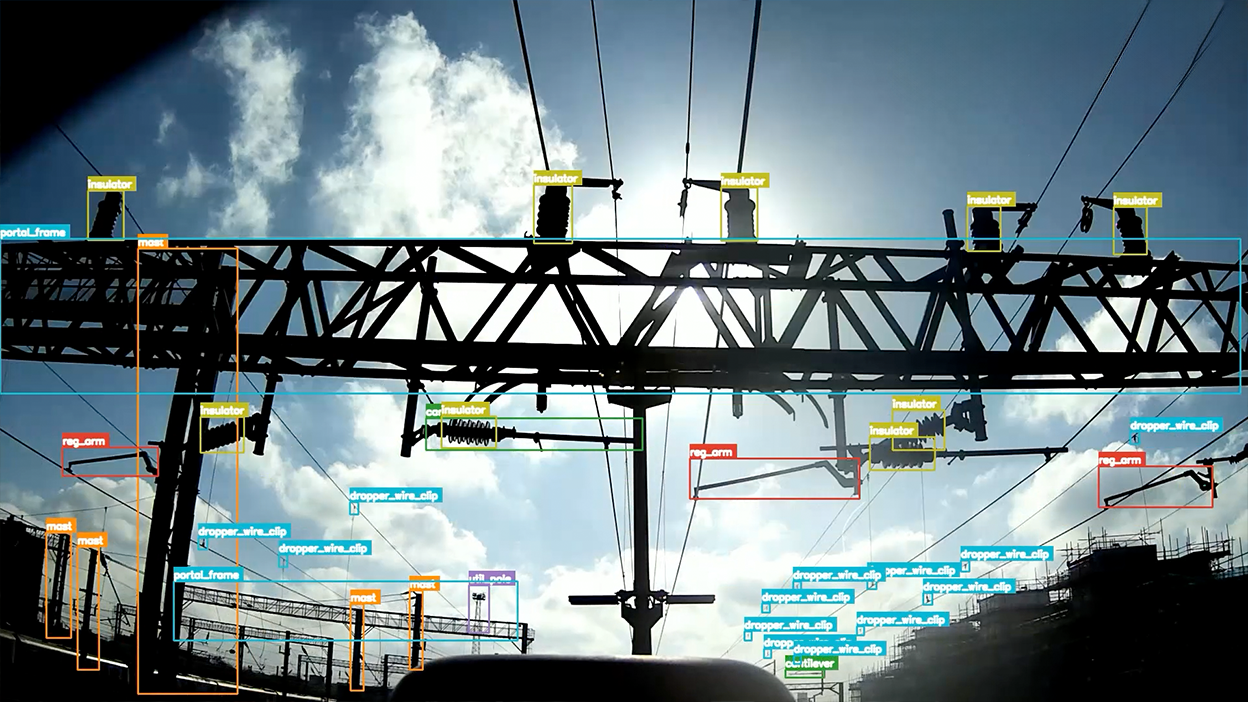
With support from the Innovate UK BridgeAI programme, Transmission Dynamics partnered with Network Rail, Angel Trains and West Midland Railway to enhance its award-winning PANDAS-V® pantograph and overhead line system with advanced artificial intelligence. The team developed RADAR (Rail Anomaly Detection and Reaction), an AI-powered system that automatically detects faults and reports them to appropriate teams. This has been rolled out across UK and international rail networks to prevent costly and dangerous service disruptions and set a new standard for rail monitoring and safety.
The challenge
Maintaining a safe and reliable electrical connection between trains and overhead lines is critical for the rail industry. Pantographs act as the connection point between train and overhead electrical lines – mechanical arms mounted on trains, which must continuously adapt to the height of the overhead wires and maintain precise contact to ensure uninterrupted power supply. However, the infrastructure is vulnerable to a range of faults: worn components, ice accumulation, wind damage, and misalignments can all lead to “dewirements”, where the overhead contact wire is pulled down or displaced. Each dewirement is not only a safety risk but can cost up to £1.5 million in repairs, delays, and lost productivity.
Traditionally, fault detection has relied heavily on manual inspections and post-incident reviews. These methods are inherently reactive, often identifying issues only after a failure has occurred. Manual checks are labour-intensive, time-consuming, and can miss subtle signs of deterioration. As a result, faults may go undetected until they escalate into major incidents, causing significant cost and disruption to passengers and operators. The sector urgently needed a proactive, intelligent solution to detect and address faults before they could impact safety or service.
The solution
Building on the proven PANDAS-V platform, Transmission Dynamics developed RADAR—a suite of five new AI-powered anomaly detection capabilities. These include detection of dropper wire faults, carbon chip wear, foliage encroachment, height/stagger misalignments, and foreign object presence. RADAR leverages self-supervised machine learning models and edge processing to monitor the condition of pantographs and overhead lines in real time. The system continuously analyses data from sensors and cameras mounted on trains and infrastructure. When RADAR detects an anomaly, it classifies the fault and can trigger autonomous safety responses. For example, if a critical issue is identified, the system can automatically lower the pantograph on approaching trains within a geofenced area, preventing further damage and ensuring passenger safety. All detected events are converted into actionable insights and routed directly to the relevant engineering teams, enabling rapid, targeted
The impact
RADAR’s real-time, AI-driven monitoring and fault reporting has reduced reliance on manual inspections and allowed engineers to focus on resolving issues rather than searching for them. Since deployment, the system has reported over 3,000 impact events to Network Rail, with the majority resolved before they could deteriorate further or cause disruption. The technology has already prevented multiple dewirements – sometimes intervening within seconds – averting significant costs and service interruptions.
Jarek Rosinski, Executive Chairman and Founder at Transmission Dynamics stated, “Every dewirement carries significant safety and financial risk. RADAR gives the industry a powerful tool to prevent these events by detecting subtle changes in pantograph-overhead line interaction and intervening before further damage occurs. That ability to act in seconds is a gamechanger for rail safety and we’re already seeing incidents that could have escalated into serious dewirements prevented as a result.”
Through RADAR, the AI model has improved auditing speed by 40% and increased detection accuracy by 6%. By automating routine inspections and enabling predictive maintenance, the system reduces the workload on maintenance crews, minimises service disruption, and extends the lifespan of trains, tracks, and wiring. On top of this, RADAR supports sustainability goals by reducing unnecessary travel and engineering interventions, lowering the environmental footprint of rail maintenance.
The future
RADAR’s advanced capabilities are being integrated into both new and existing PANDAS-V deployments, with large-scale rollouts across the UK and internationally. The system is now being specified in tenders worldwide, positioning Transmission Dynamics as a global leader in AI-driven rail infrastructure monitoring. Ongoing development will further enhance the system’s accuracy, expand its detection capabilities, and integrate with broader digital rail initiatives.