

Inside BridgeAI podcast: How UK businesses are putting AI to work
What does it actually take for a business to adopt AI, not the hype, but the practical reality? This five-part podcast mini-series goes behind the scenes of Innovate UK BridgeAI, the £100 million programme launched in 2023 to help UK businesses adopt AI safely and responsibly.
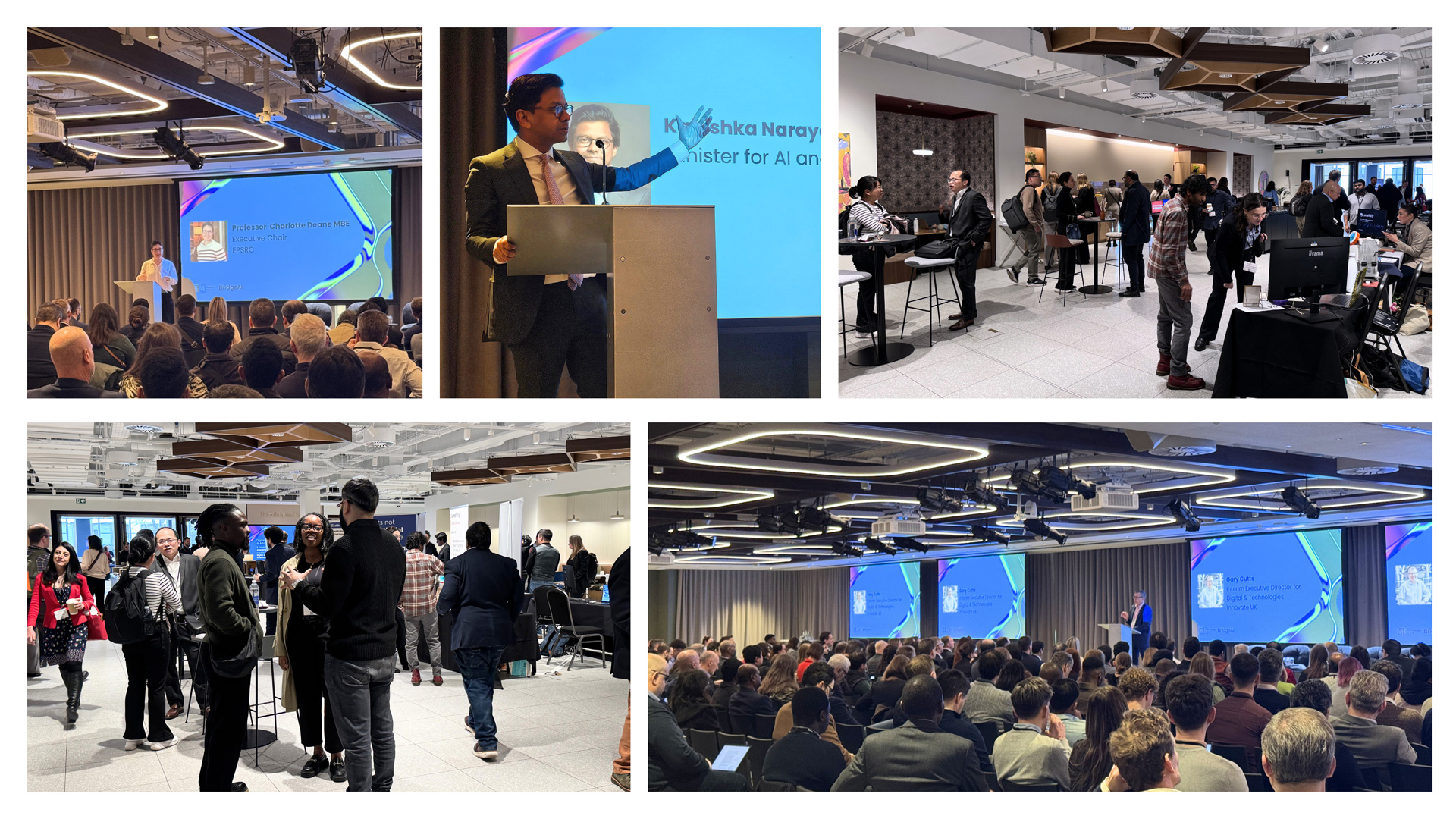
Photography taken on 9 March 2026 at the Innovate UK BridgeAI 2026 showcase
Over three years, BridgeAI engaged more than 12,000 people and supported 5,000 organisations across four sectors with huge untapped potential: agrifood, creative, construction and transport. It funded over 820 projects and delivered more than 1,700 training courses all through a unique partnership between Innovate UK, the Alan Turing Institute, Digital Catapult, the STFC Hartree Centre and the British Standards Institute (BSI).
Across five episodes, host Peter Schmidt talks to the people who designed and delivered the programme, and, crucially, to the businesses who used it. You’ll meet a ceramicist using machine learning to reinvent ancient glazes, a family-run haulage firm writing tenders with AI, a startup whose robots monitor football pitches, and the organisations who helped them along the way.
Whether you’re AI-curious or already deploying it, this series offers an honest, jargon-free look at what AI adoption really looks like – what worked, what was hard, and what comes next.
Listen to the episodes below and on all popular platforms, including Innovate UK’s Spotify channel.
Episode 1: What is BridgeAI, and did it work?
Why did the UK launch a £100 million programme in 2023 to help businesses adopt AI, and what happened next?
Three voices tell the story:
- Nicolas Guernion, Director of Partnerships at the Alan Turing Institute, explains how the national institute for data science and AI became a delivery partner from day one, providing businesses with free, independent scientific advice from over 250 expert engagements
- Richard Cooper of Innovate UK Business Connect reflects on why theprogramme targeted agrifood, construction, creative and transport: sectors rich in data but slower to benefit from AI, and shares a surprising lesson about the companies in the “grey area” between AI adopters and AI developers
- Dominica D’Arcangelo,BridgeAI Programme Manager at the Turing, lifts the lid on what it takes to work effectively as five major organisations delivering one
An essential introduction to how BridgeAI worked, what it achieved, and where it might go next.
Episode 2: AI down on the farm and beyond
Agriculture and food contribute over £150 billion to the UK economy. How can AI help a sector that’s been around for thousands of years?
In this episode, we meet Professor Po Yang of the University of Sheffield, one of BridgeAI’s independent scientific advisors, who has personally advised 34 small businesses. He explains how AI has quietly powered “precision agriculture” for a decade; from pest-detection apps and vertical farming simulators to weeding and harvesting robots that work around the clock, and why cost and market size, not technology, are often the real barriers to adoption.
Then it’s over to Erwann Lompech-Leneveu, co-founder and CEO of E-Nano, a London startup whose robotics and imaging systems monitor the health of football pitches, golf courses and racetracks. Erwann shares how BridgeAI’s expert advice helped E-Nano build trustworthy AI models from small datasets, proving you don’t need millions of data points, just the right ones.
A lively tour of AI well beyond the chatbot: image analysis, robotics, simulation and decision support, all in service of grass, crops and the people who tend them.
Episode 3: AI and the creative sector, beyond generative AI
No sector has debated AI more intensely than the creative industries. But step past the headlines about generative AI, and you find artists using machine learning in remarkable, unexpected ways.
Meet Layla Hashim, ceramic artist and solo founder of Box O Fun. Her obsession with the chemistry of ceramic glazes outgrew her spreadsheets, so, with BridgeAI’s help, she built a machine learning model spanning half a million data points to predict how glazes behave in the kiln. Her journey now weaves together data science, sustainability and her Iraqi heritage, as she searches for ancient, local materials that modern AI can help rediscover.
- Rebecca Duke, Principal Data Scientist at the STFC Hartree Centre, explains how innovation vouchers gave over 100 businesses access to researchers and supercomputing and why poor data management is the single biggest blocker she sees in small companies.
- Jimmy Jarvis of Digital Catapult describes the accelerator programmes that matched startups with industry giants like Transport for London and Merlin Entertainments with 93% of accelerated startups still trading today and over £3 million in follow-on investment.
Episode 4: AI on the move: transport, logistics and the power of standards
Transport runs on data: telematics, asset systems, customer records, decades of engineering documents. So why has so much of it gone unused?
- Jamie Sands, Head of Solutions at family-runlogistics firm Welch Group, gives a refreshingly candid view from the cab. He explains how an independent operator in a low-margin industry uses AI today: off-the-shelf tools that draft tender documents in minutes, AI built into transport management systems, and specialist route A BridgeAI scientific advisor even helped them weigh a fourth option: building their own tools.
- Liam McGee, Chief Scientist atKaiasm, works where it’s most important to be right: critical national infrastructure. He explains knowledge graphs, data readiness and why preparing decades of rail, road and utilities data for AI is the next big frontier, and how the BridgeAI community cured his small Somerset team’s “intellectual loneliness”.
- Finally, Nathan Parker of BritishStnadards Institute demystifies standards: why ISO 27001 and the new AI management standard ISO 42001 matter to small businesses, and how BSI’s BridgeAI training sold out within 48 hours.
Episode 5: Building with AI: construction, data and trust
In the final episode of the series, the focus turns to construction and the built environment; a sector sitting on decades of valuable but messy data, from hand-drawn plans in records rooms to cutting-edge digital building models.
- Tom Goldsmith, CTO and co-founder of Hoppa, explains how AI helps construction teams make sense of unstructured data: engineering reports, drawings, and maintenance records, so the right information reaches the right people at the right time. With assets built to last 50 or even 100 years, he argues, better information managementisn’t optional: it’s essential to extending the life of our infrastructure and cutting carbon.
- Max Smith, Director ofEluxevo, is on a mission to decarbonise buildings by rethinking how we experience them, using AI to connect lighting, heating and human comfort into one intelligent, energy-efficient system. He recounts a journey through nearly every part of BridgeAI: STFC innovation vouchers, Turing expert advice, BSI standards support and more.
The episode closes with reflections on the whole series: what 12,000 conversations about AI taught the programme, and why ‘trust not technology’ may be the real foundation of AI adoption.
Programme
This article is part of AI.
Robotics and Artificial Intelligence are significant globalised technologies applicable to every sector. The UK’s extensive industrial and academic research base has immense potential to impact on home and global markets.