

Robotics adoption in the UK - The real innovation challenge
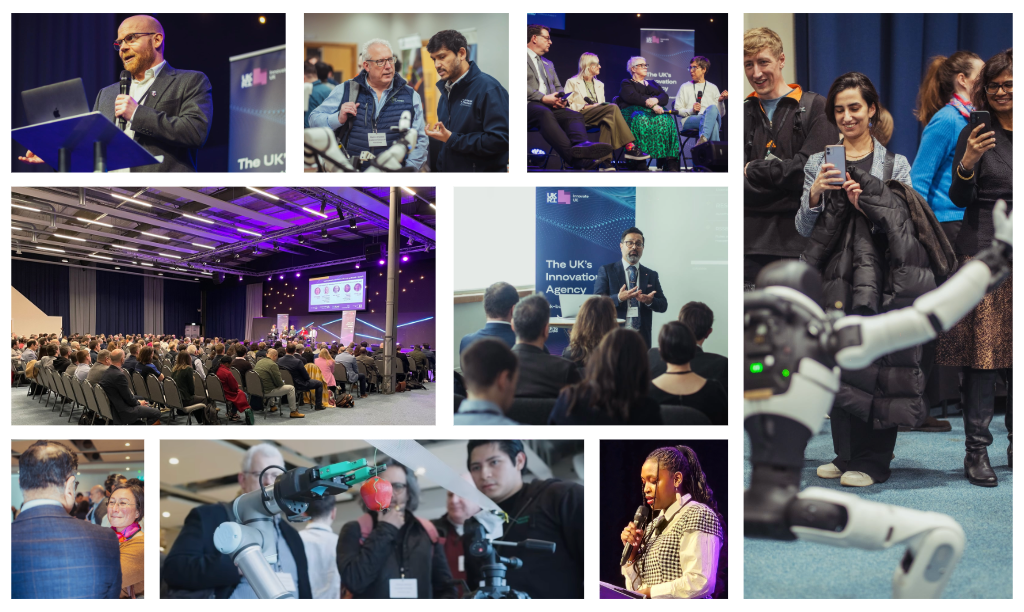
As part of the Innovate UK Robotics Adoption programme, our Robotics Industry Showcase 2026 in Milton Keynes demonstrated that the UK has world-class strength in robotics R&D and highlighted how adoption could be realised.
In this perspective, Agnes Wamagui our Knowledge Transfer Manager in Robotics, presents lessons learned and shared experiences from the event which highlighted why integration and real‑world evidence matter more than ever.
Highlights from the event
On Tuesday, 3 March 2026, we welcomed hundreds of innovators, adopters, regulators, investors, researchers, and public sector leaders from the UK robotics ecosystem to discover latest robotics technologies and explore opportunities that may enhance services, and create safer, more resilient smart city systems in transport, energy, healthcare, waste management, education, and public safety.
Led by Innovate UK with partners Department for Science, Innovation and Technology (DSIT), techUK, Milton Keynes City Council and Smart City Consultancy, this showcase featured the summit around accelerating robotics adoption, interactive solution hubs, a highly dynamic exhibition and a robotics runway of start-ups and well-known brands, as well as plenty of networking and 1-2-1 meetings.
Watch video highlights from the showcase
Latest insights in enabling robotics adoption
Across every session, panel, conversation, and live demonstration, the message that kept resurfacing was that the UK is rich in capability and that adoption remains a system challenge.
Whilst the UK has strong clusters, and a growing pipeline of innovators, the need now is to move from pilots to procurement and from demonstrations to routine use.
Participants described the current opportunity of adoption as not lacking in technology, but a system change that needs work in:
- integration into live environments
- assurance evidence
- organisational readiness
- regulatory clarity
- repeatable deployment pathways.
These themes were echoed across panels, from DSIT’s keynote to discussions with Milton Keynes City Council, NVIDIA, Apian, and the Robotics Proving Ground network.
Watch the full conference recording on YouTube for the complete insight and energy.
Key takeaways from the showcase
DSIT’s framing of 2026 as an inflection point
Robotics is now embedded across national strategies including manufacturing, health, defence, and infrastructure. This means the UK must focus on growth in robotics and growth through robotics.
Milton Keynes as a living testbed
The long‑term “city as a testbed” mindset shows how agile procurement, organisational openness, and shared infrastructure enable real deployments.
Industry calling for platform foundations
NVIDIA and others stressed that scaling robotics depends on simulation, digital twins, and standardised compute platforms and not just hardware innovation.
End users asking for integration, not novelty
Hospitals, airports, and stadiums all asked the same question: “How does this fit into our workflow, our safety model, and our operational reality?”
The proving‑ground network emerging as critical infrastructure
Manufacturing, offshore, agriculture, and space leaders all converged on the same point: real‑world testing is the bridge between innovation and trust
Skills and investment shaping deployment readiness
Insights show that skills and investment are tightly connected. Organisations need the right capabilities to deploy robotics, and investors need confidence that those capabilities are in place.
The shift from innovation to deployment is now unmistakable
The UK is rich with ideas and prototypes, and the next phase of UK robotics is about deployment at scale. Rather than more prototypes, the following points are to be considered first:
- real-world evidence is the new currency, with trust built through repeatable testing and sector‑fit assurance.
- proving grounds are becoming essential, enabling safe, realistic, and defensible testing.
- integration is the real work, with adopters buying capability, not hardware.
- regulatory clarity is rising in importance, with system level assurance becoming the expectation.
Attendees valued the conversations that bridged innovation to implementation yet struggled to identify who is deployment ready, which mirrors the broader adoption challenge of having the chance to accelerate progress when pathways are clear and evidence is visible.
Another key topic of conversation was the “hidden tax” of robotics adoption – where integration effort, assurance evidence, data access, skills gaps, and total cost of ownership are perceived as barriers to progress.
Innovation is no longer just invention, it is integration, assurance, and real‑world deployment.
Agnes Wamagui, Knowledge Transfer Manager – Robotics, Innovate UK Business Connect
What can be done now?
Barriers to innovation reaching the market can be broken down through opportunities that can help organisations:
- access test environments and design for workflow fit
- de‑risk trials and build trust through evidence
- navigate regulation and understand standards
- integrate with legacy systems and prove value in live operations.
To support this work, Innovate UK Business Connect can:
- ensure that end‑user needs shape the next wave of innovation
- connect organisations to build the skills and partnerships that make innovation deployable
- strengthen investment confidence by enabling evidence
- bolster national alignment so innovation can scale.
DSIT, local authorities, the Catapult Network, industry, and adopters all expressed a desire for more joined‑up pathways. By connecting regional strengths, aligning programmes, supporting adoption hubs, and sharing lessons across sectors – we can support infrastructure to meet the needs of the growing robotics ecosystem.
Be part of UK robotics adoption
Explore opportunities to drive your innovation from idea to deployment:
Advanced connectivity technologies
Apply by 13 May for a share of up to £25m to develop secure, sustainable or sovereign connectivity technologies that support the UK’s Advanced Connectivity Technologies programme.
Medicines manufacturing
Businesses within the pharmaceutical industry can apply by 27 May for a share of up to £7.5 million to support the development and use of digital, automated, and robotic technologies with the Medicines Manufacturing: Labs of the Future opportunity.
Agri-tech manufacturing
Second phase funding for rounds for AgriScale – Accelerating Agri-tech manufacturing: Experimental Development and Accelerating Agri-tech manufacturing: Industrial Research opportunities are open until 3 June. For those seeking an international opportunity within agriculture, you may wish to consider the Global Incubator Programme: Agri-Tech Australia Farmers2Founders (F2F) for which applications close on 21 June.
UK defence innovation and aviation technologies
The UK Defence Innovation: Map the Gap (Phase 3) could offer £2m total funding for proposals that can remotely assess terrain stability and measure rivers and nearby areas, to support safe and rapid traversing of land forces. Applications close on 16 June. UK registered organisations can also apply for a share of up to £10 million for the development of aviation technologies and systems that support both civil and military use cases by 3 June.
Space and aerial systems
The popular Horizon Europe programme welcomes businesses, universities, research institutes, charities and not-for-profits to apply for the Digital, Industry and Space (Cluster 4) Work Programme, and UK registered organisations can also apply by 3 June for a share of up to £5m to develop dual use (civil & military) technologies to counter Uncrewed Aerial Systems (UAS).
Advanced manufacturing and materials
The Advanced manufacturing supply chain innovation: CRD opportunity remains open for applications until 10 June, and as part of the Advanced Manufacturing Sector Plan, the National Materials Innovation Programme: Feasibility studies Rd 2 is open for applications until 24 June.
Knowledge Transfer Partnerships
UK registered academic institutions, RTOs or Catapults can apply by 24 June for a share of up to £10 million to fund innovation projects with businesses through the Knowledge Transfer Partnership (KTP): 2026 – 2027 Round 2.
Regulatory Innovation Office discussions
There is also an opportunity to participate in discussions on regularity barriers in robotics as the Regulatory Innovation Office (RIO) is looking to hear from businesses facing regulatory challenges to help shape how the RIO supports innovators, and to inform the action they take with regulators to help unblock barriers to innovation. Full details, including how insights and data will be used visit Regulatory Innovation Office: Front Door pilot phase 2 – business insights – GOV.UK.
How can we help you?
To discuss your organisation’s priorities and to explore potential next steps for robotics adoption and collaboration opportunities, get in touch with our expert Agnes Wamagui.

Related programme

Robotics Proving Ground
Pioneering robotics evolution through powering a network of hubs to fast-track robotics from concept to market.