

Exploring future opportunities for robotics and automation in UK agriculture
Automation and robotics have an important role to play in helping UK agriculture respond to labour costs and shortages, rising input costs, productivity pressures and climate volatility. The opportunity is to target repetitive, physically demanding or hard-to-monitor tasks where technology can support decision making and improve efficiency, resilience and safety.
Defra’s Farming Innovation Programme, delivered in partnership with Innovate UK, will soon be sharing further details about the Farming Futures: Automation and robotics funding competition which will open for applications on 3 August 2026. Funding is available for innovative businesses, researchers, farmers, growers and foresters to collaboratively develop and test ambitious solutions for robotics and automation in agriculture and horticulture.
With significant investment and research into automation and robotics for agriculture, and a turbulent few years for many UK robotics companies, we look at some opportunity areas for future innovation and collaboration. In this article, Joanna Scales, Knowledge Transfer Manager – UK and International AgriFood at Innovate UK Business Connect, spoke to several experts to hear their thoughts including:
- Ali Capper, Chairman of British Apples & Pears
- Simon Pearson, Professor of Intelligent Robotics and Interactive Systems at University of Lincoln)
- Raymond King, Chartered Agricultural Engineer, co-host of Brash Ag Podcast, and Managing director of Flynt Technology
- Matthew Dobbs, Vet and Co-founder of AgSenze and HerdVision
- James Simpson, Managing Director of Adrian Scripps Ltd
Here are the key UK agriculture robotics and automation focus areas and innovation opportunities identified:
-
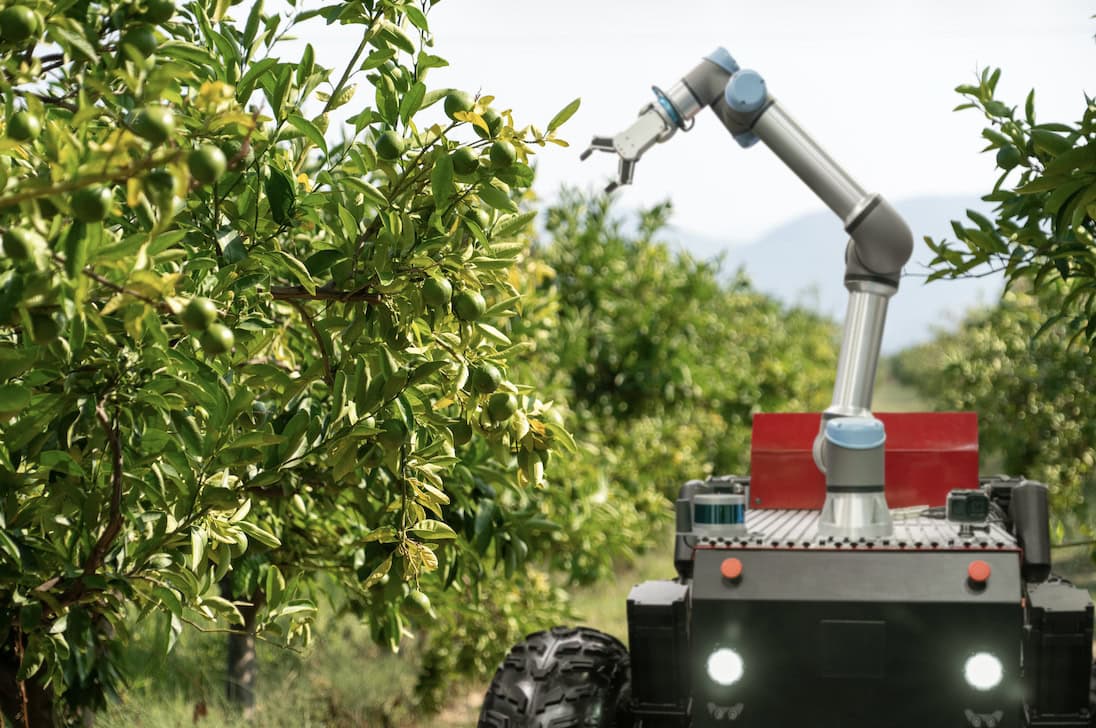
Self-propelled platform technologies have made it more efficient for people to pick fruit but there is space to further improve efficiency through introducing AI robotic systems to orchards. Collaborative innovation for improved accuracy and speed is needed to make robotic systems effective for fruit farming tasks (for example harvesting, thinning, pruning or spraying).
Although many packhouses are already using automated grading and pack-line systems, innovation to explore robotic systems could further automate the grading and packing of crops.
- AI-enabled robotic harvesting. Systems that can pick individual fruits, based on colour and size, with the accuracy and efficiency of a human.
- Robust autonomous systems which can work in all weather or light conditions and travel on the ground, not tracks. Ultimately the desire would be to have a multi-purpose system which can both harvest fruit and be switched out to do other high-labour tasks, like thinning, pruning or spraying.
- Human-centred training. Tracking the techniques of the best pickers could inform training modules.
-
The application of automation and robotics in arable crops is increasing, with autonomous machines for crop production being sold commercially. Drivers for robotic agriculture include operational cost, potential to reduce soil compaction and reducing inputs requirements.
- Smarter monitoring of implements behind autonomous tractors. Farmers need reliable sensing systems that indicate whether a cultivator, drill or other implement is doing the job correctly, and when a human operator needs to intervene.
- Retrofitting autonomy to existing machinery. Autonomous kits that work across different tractor brands could help farmers unlock value from existing hardware, while retaining the option for manual driving.
- Swarm robotics. Smaller autonomous machines could reduce soil compaction, spread operational risk and create more flexible working patterns, but they need robust coordination.
- Farm-level robot logistics and asset management. Software is needed to help farmers manage autonomous assets across split fields, road networks, changing weather windows and time-critical operations.
- Cybersecurity and safe operation. As farm machinery becomes more connected, systems will need safeguards to prevent data theft, remote interference or unsafe control of autonomous equipment.
-
Driven by seasonal worker quotas and high labour costs, the UK horticulture robotics sector is transitioning from experimental trials to active commercial deployment.
- Selective harvesting in complex crop environments. Crops such as mushrooms and soft fruit need robust end effectors with gripping and grasping systems that can handle delicate produce without damage.
- Pack house operations for horticultural crops such as tomatoes. Equipment to assess and sort produce for size, defects and quality and then present and pack for sale.
- Vision and control systems for crop recognition. Advances in machine vision, recognition and control systems could be adapted for horticulture to help robots identify crops that are ripe and of the right quality ready for harvest, or pests and diseases, accurately and make faster, reliable decisions in complex growing environments.
- Autonomous platforms linked to specialist tools. Modular platforms that can carry different end effectors, sensors or handling systems could support multiple crops and reduce reliance on single-purpose machines.
- Digital twins and simulation for system design. Robust simulation tools could help growers and innovators test layouts, workflows and robot interactions before committing to expensive infrastructure changes.
-
For farmed animals you could split automation and robotics technologies into different areas:
- Innovations which sit in or on the animal (for example collars/bolus technologies).
- Remote animal monitoring systems (for example cameras/microphones).
- Environmental sensing.
- Operational innovations (for example feeding/milking systems).
- Intelligent data management and processing tools that use Artificial. Intelligence/Machine Learning to provide data insights and provide executable management decision outcomes.
Wearable and bolus technologies are already relatively mature, particularly in dairy and other ruminant systems, where longer production cycles and the need for individual animal data make the value proposition clearer.
Greater future opportunity may sit in remote monitoring technologies. These are more nascent but could allow the monitoring of individuals or groups with less interference and less physical hardware. Remote systems could have relevance across dairy, beef, pigs and poultry, supporting areas such as welfare assessment and decisions around when animals enter the food chain.
Environmental sensing is another important area, including monitoring ventilation and temperature, or broader building or pasture conditions. Within pastures, this overlaps with satellite, drone and camera technologies for grass growth and animal location monitoring. Operational innovations in many cases (especially in dairy/beef) could focus on retrofitting to existing systems, rather than total replacement of existing facilities.
- Better image granularity. Improved image quality and resolution is needed so camera-based systems can reliably identify individual animals and detect subtle behaviour or welfare changes.
- Edge computing to process data on farm. Processing video and sensor data locally could speed up decision-making and allow farmers to act on information quickly, even where connectivity is limited.
- Translation of information into action. Technologies need to connect with farm databases and convert sensor, camera and performance data into clear outcome measures and practical recommendations or actions.
- Retrofit systems for existing livestock buildings. Many UK livestock units operate from traditional buildings or face planning and infrastructure constraints, so technologies that can be retrofitted into existing systems may offer a more realistic route to adoption than fully purpose-built robotic facilities.
Collaboration and systems thinking is required for success
Across all sectors, the strongest opportunities for robotics and automation will come from collaboration between a broad range of stakeholders including farmers, growers, researchers and technology developers.
Many technical challenges are shared across crop and livestock systems, so closer collaboration could help avoid duplicated effort, accelerate learning and build greater confidence in solutions that are ready for commercial use. Innovation needs to start with a clear understanding of how farms operate and how users want to be communicated with. Technologies are more likely to be adopted when they fit into existing systems, rather than asking businesses to redesign everything around a single piece of equipment. Rural connectivity will be important to support autonomous technologies, data sharing between systems and the reliable transfer of information from farm to decision-support tools.
Future progress will also depend on thinking about the farming system as a whole. This could include breeding crops to suit automated systems and designing canopies or growing facilities with automation in mind, as well as developing retrofit approaches that allow robotics to work within the diverse systems already found across UK agriculture.
If you have ideas about how to address any of the challenges indicated here or are looking to apply to the robotics and automation competition and would like to speak to someone about your application, please get in touch with the Innovate UK Business Connect AgriFood team