

The role of heat networks in whole system finance
To reach net zero by 2050, significant investment is needed in net zero projects. The scale of the decarbonisation challenge is huge and involves delivery of numerous project types across the whole energy system. Delivering those projects requires finance at scale, far exceeding the resources available to local authorities. Given current economics, grants or commercial structures, different project types have different levels of attractiveness to the private sector; heat networks play a central role in this.
This guide provides insights into the role of heat networks in whole system finance and detailed advice relevant to local authorities thinking about developing these types of projects.
We have included video extracts giving perspectives from investors, business, local authorities and government, from an in-depth webinar on the subject held as part of the Net Zero Living Programme in January 2025.
What is whole system finance?
Whole system is an approach to management and analysis that considers the entire ecosystem rather than focusing on isolated elements such as individual transactions or segments. Instead of thinking about how to progress individual projects within individual technology areas, a whole system approach considers how to bring everything together into a unified, region-wide approach.
In finance, a whole system approach can mean:
- Bundling: The idea of bringing high and low yielding projects together to create a single viable opportunity.
- Revenue stacking: The idea of bringing together different income streams from across traditional silos.
- Blended finance: Public and private sector funding are brought together to optimise for scale (or risk) versus cost of capital.
For more details, please refer to the insight report Unlocking Climate Capital: A Business Case Framework for Local Authority Net Zero Projects which provides a standardised approach and related tools to help local authorities identify a range of different financing options and appraise and select the right model for them.
In this clip from our webinar, watch Alasdair Silverman of the Department of Energy Security and Net Zero (DESNZ) discuss how heat networks can be part of wider packages when planning and financing net zero initiatives.
Benefits of whole system finance
The benefits of whole system finance can be divided into two categories: benefits to local councils, and benefits to private investors.
For local authorities, benefits can include lower cost, reduced grid dependency, less need for renewables, access to private investment and lower consumer bills.
Benefits to investors can include higher returns, reduced technology risks, better scalability, increased project readiness and social value creation.
Balancing idealism and pragmatism
Each project type has a different set of underlying economics and investment “readiness” levels. Moreover, there is a trade-off between focusing on tried-and-tested projects that are deliverable versus trying to develop a whole system approach that delivers everything whilst increasing complexity. The local authority needs to find a balance between idealism and pragmatism suitable to its needs.
Why heat networks?
Heat networks are well placed to act as anchor projects that attract investor interest. They offer a range of strengths that make them appealing to strategic partners.
When assessing which anchor projects are most attractive to investors, several criteria shape what is considered a high value opportunity.
Key criteria include:
- Likelihood of project viability – how realistic it is that the project can be delivered successfully.
- Planning powers – the degree of influence to secure permissions and navigate local planning processes.
- Relevant assets or partnerships – existing infrastructure, land, or strong local partners that can accelerate delivery.
- Project scale and aggregation – opportunities that can easily aggregate to authority-wide scale.
- Private investment deliverability – a tried and tested investment pathway with delivery confidence.
- Government capital funding – access to public funding that can de-risk early stages of delivery.
- Development funding – the availability of support for feasibility, design, and early-stage planning.
Research from City Science highlights that heat networks score highly across these criteria, making them some of the most viable options when compared with other local decarbonisation projects. See the figure below which compares the key criteria across various decarbonisation solutions.
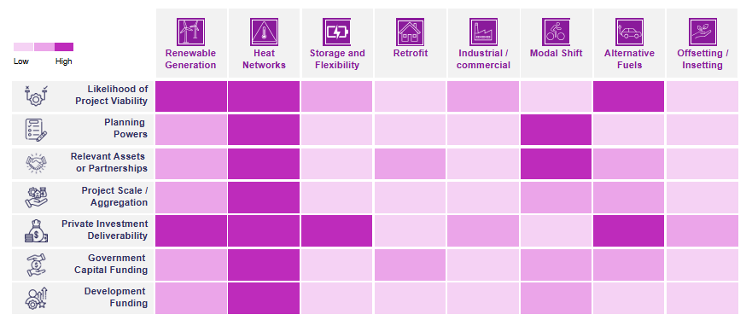
Thus, heat networks are central to councils’ investment plans and decarbonisation journey. Relevant case studies are:
- Bristol City Leap: Bristol City Leap is a 20-year joint venture between Bristol City Council and Ameresco. Bristol City Leap’s Initial Business Plan comprises two key elements, the Low Carbon Energy Infrastructure Plan and the Heat Network Plan.
- Midlothian Energy Limited: This is a 50:50 joint venture between Midlothian Council and Vattenfall Heat UK. It has a long-term business plan to invest £100 million in low-carbon energy projects, starting with an energy centre and heat network.
- Glasgow LHEES: Glasgow declared a climate and ecological emergency in 2019 and launched its climate plan in 2021. Its local heat and energy efficiency strategy (LHEES) is estimated to cost in the region of £10-15 billion to deliver and its focus areas include heat networks.
The main benefit of heat networks is to provide a means of significantly decarbonising heat supply. Also, there are potentially significant second-order benefits:
- Social benefits: Provision of low carbon, sustainable heat to social housing residents
- Energy security: Move toward security of supply, with lowered exposure to external market forces
- Local growth: Supply chain capability is limited, which presents opportunities for growth to local businesses
- Economic benefits: Potential to internalise the economic benefits of the energy market
- Skill creation: A new industry presents opportunities to create skills, generate skilled jobs and growth
Watch what our webinar experts shared on why heat networks matter.
What drives success?
The characteristics of heat networks influence the critical success factors that the local council needs to consider.
| Characteristics | Critical success factors |
|---|---|
| Large scale Heat networks operate on a large scale, serving many consumers over expansive areas |
Scalable infrastructure The local authority needs to design with scalability in mind, allowing for future expansion as demand grows |
| High CAPEX Significant upfront capital expenditure (CAPEX) is required for initial development and infrastructure |
Securing diverse funding A range of funding options, including government grants and private investment, are required. |
| Economic evolution Early phases have high costs, but economics improve as the network expands |
Long-term planning Financial model should include long-term perspective as returns improve as the network expands |
| Private interest Increased interest from private capital, such as infrastructure funds, is shaping the sector |
Diverse models Various commercial models are used to create public-private partnerships, with no standard approach |
| Consumer dependency The cost of heat for consumers is influenced by the choice of heat sources |
Consumer protection Policies are being developed that need to be considered in heat network development |
| Electrification exposure Electrification of heat systems exposes projects to fluctuations in electricity prices |
Mitigate risk The local authority needs to explore options for diversifying heat sources to reduce exposure and thus risk |
In this clip from our webinar, hear Harry Askew of SSE and Gavin Slater of Glasgow City Council discuss critical success factors.
Benefitting from policy tailwinds
The Energy Act 2023 introduces regulatory measures for heat networks, to promote the development of low-carbon heating solutions. Ofgem is being appointed as regulator for heat networks. These policies allow:
- Heat network zones: Zones are expected to be designated by 2025. Local authorities will have a key role in designating the zones. Heat network zoning will include an obligation to connect which increases the certainty of success for heat network projects and give developers and investors more certainty about the number of likely connections to networks
- Governance: Heat networks will be overseen by Ofgem and local coordinators, with councils playing a key role
- Consumer protection: Ofgem is currently working on standards to protect consumers
These major policy ‘tailwinds’ increase the attractiveness of heat networks. The market is moving towards private capital, but at the same time government support such as from the Green Heat Network Fund signals trustworthiness and increases a local authority’s chance to attract private investors.
Thus, to finance heat networks, a combination of government resources and investment capital is required.
Watch what our webinar speakers had to say about the current state of play on sources of investment.
In these clips, Alasdair Silverman of DESNZ discusses the role of regulation and standards and how heat zoning models will work to facilitate heat network rollout.
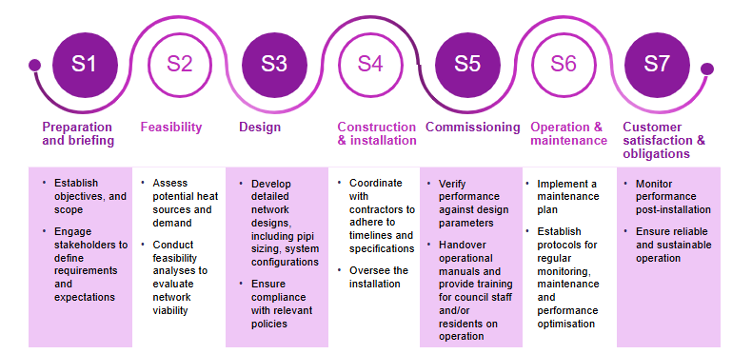
The 7-step process for heat network development
Step 1: Preparation and briefing
- Establish objectives and scope
- Engage stakeholders to define requirements and expectations
Step 2: Feasibility
- Assess potential heat sources and demand
- Conduct feasibility analyses to evaluate network viability
Step 3: Design
- Develop detailed network designs, including pipe sizing, system configurations
- Ensure compliance with relevant policies
Step 4: Construction and installation
- Coordinate with contractors to adhere to timelines and specifications
- Oversee the installation
Step 5: Commissioning
- Verify performance against design parameters
- Hand over operational manuals and provide training for council staff and/or residents on operation
Step 6: Operation and maintenance
- Implement a maintenance plan
- Establish protocols for regular monitoring, maintenance and performance optimisation
Step 7: Customer satisfaction and obligations
- Monitor performance post installation
- Ensure reliable and sustainable operation
Infographic showing the 7-step process for heat network development.
Developing heat networks
The following Q&A provides helpful insights and advice for local authorities on heat network development.
-
The essentials are to conduct feasibility studies and zoning studies. Moreover, it is helpful to gain an overview of the support available. After the groundwork, the local authority can engage the market and should consider a wide range of partners, suppliers, etc.
If you’re already identifying your heat sources, if you’re already identifying appetite within the local authority buildings who are in the centre of your settlement of your city or town, then that’s a good place to start.
– Alasdair Silverman, Department for Energy Security and Net Zero (DESNZ)
Watch more from the webinar on how to get started when developing a heat network.
-
It is beneficial to engage early with national partners, such as the Net Zero Hubs, DESNZ, National Wealth Fund and Triple Point. Engagement could also include suppliers and potential strategic partners: Local authorities could consider a joint development agreement (JDA) which enables collaborative development between the council and its chosen energy company. The advantage of a JDA is that it helps with getting funding for the required development capital, but it may also lock the council in with a specific supplier. Local authorities will need to make sure procurement are involved in any decision to enter into a JDA. Additionally, the local authority might need to procure specific advice, e.g., on financial modelling, if that capability is not available internally.
-
National partners such as National Wealth Fund and Triple Point provide capital and advice that help guide the development of heat networks as well as the application for capital, so it is beneficial to reach out even before the fundraising stage. Moreover, DESNZ can also provide support, especially regarding heat network zoning.
And if you contact the department and say that you’re […] seeking support and you want to work with the department to bring zoning as quickly as possible, we’re always open to hearing that.
– Alasdair Silverman, Department for Energy Security and Net Zero (DESNZ)
-
Procurement, especially the long timeline of public procurement, can negatively impact a heat network project. In practice, procurement dependencies that lead to blockage of the financial closure are observed. To resolve this, local authorities play a key role as they coordinate the collaboration between constituent parts. A faster procurement process that is still compliant would be beneficial. One of the key things local authorities need to do is engage with procurement, legal and S151 officers early to smooth the governance to enable these transactions to happen.
We’ve got a depressing tonne of real-world examples […]. Getting stuck in a 12-month governance board and then procurement cycle really isn’t helpful.
– Ken Hunnisett, Triple Point
-
Glasgow City Council secured £4 million of internal funding to develop its whole system finance approach for the city. In the webinar Gavin Slater, Head of Sustainability, shared his insights on this topic and pointed out that the key is to showcase clearly how the investment would unlock a much larger investment into the city.
One also needs to show that investment would not just contribute to decarbonisation but would also generate return. And one needs to demonstrate that heat networks are part of a whole system approach that will unlock investment into the area.
The real key here was to try and explain clearly how making that investment would unlock a much larger investment into the city.
– Gavin Slater, Glasgow City Council
-
It is important to follow the whole system approach when it comes to decarbonisation, but it may be better to start with one part of the whole system (for example heat networks) than to try to realise the entirety at the same time. To enable the pursuit of ‘whole system’ in the future, it is advisable to design networks with the whole system in mind.
Too much ambition – perfect is the enemy of good […]. Sometimes people’s first stop on the journey is to go to Z, straight to Z, about this super duper net zero clean, multifaceted […] proposition, which is just incredibly difficult to deliver […]. It’s expensive; how do you even begin to procure it? I think sometimes a bit of pragmatism is required. And maybe […] just breaking it down at the deliverable chunks rather than starting, you know, this wonderful, enormous scheme.
– Peter Chalmers, National Wealth Fund
-
The key one, and I think what everyone asks, is the role. What role does the local authority want to play?
– Shivali Mathur, Amberside Advisors
It is crucial to get clarity on what role the local authority wants to play. The two key roles to consider are enabler and investor. If the role is clear, selecting the right commercial model becomes easier. City Science can provide support with its tried and tested workshops on local authority roles.
Watch the webinar recording
If you want to find out more about the role of heat networks in whole system finance, you can watch the recording of the whole webinar, or review the highlights from the list below. Hear insights from experts from DESNZ, South West Net Zero Hub, Kensa, Amberside Advisors, Triple Point Investment, National Wealth Fund, SSE Energy Solutions, Glasgow City Council and City Science.
Review the highlights
- How heat networks can be part of wider packages when planning and financing net zero initiatives.
- Expert Ken Hunnisett from Triple Point shared on the benefits of whole system finance.
- Speakers from City Science and National Wealth Fund explore finding a balance between idealism and pragmatism.
- Watch what our webinar experts shared on why heat networks matter.
- Harry Askew of SSE and Gavin Slater of Glasgow City Council discuss critical success factors.
- Watch what our webinar speakers had to say about the current state of play on sources of investment.
- The role of regulation and standards in heat network development.
- How heat zoning models will work to facilitate heat network rollout.
- How to get started when developing a heat network.
- How local authorities can secure internal development funding for a Whole System Finance approach.
- The role of the local authority in heat network development.
Related programme

Net Zero Living
A new wave of place-based innovation is transforming UK towns, cities and communities. Innovate UK has been helping local authorities and businesses work together to deliver new solutions that improve local services and open markets for economic growth.