

Major new materials programme announced
A new £80m programme to speed up the time it takes to turn advanced materials science into real-world products has been launched.
A coordinated national approach
The National Materials Innovation Programme (NMIP), delivered by Innovate UK and Engineering and Physical Sciences Research Council on behalf of UKRI, will establish a more coordinated national approach to advanced materials, helping to accelerate the translation and adoption of UK innovations across priority industrial sectors.
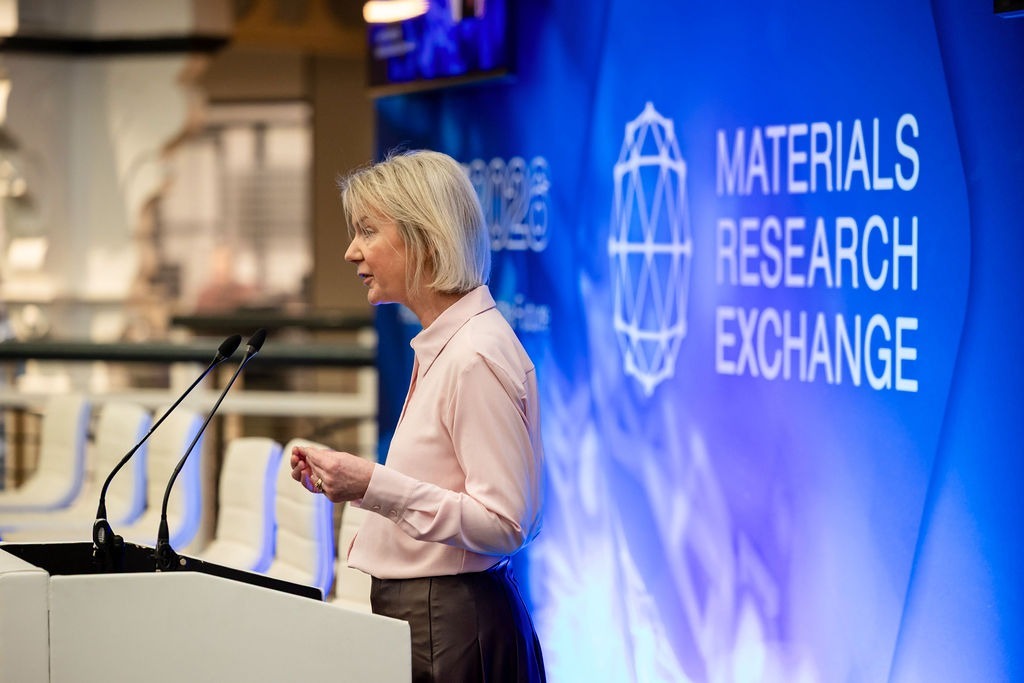
The announcement was made at the Materials Research Exchange 2026 (MRE), the UK’s flagship event showcasing the very latest in materials science and innovation. Now in its 12th year, MRE brings together a vibrant community of innovators, investors, researchers and policymakers.
Chairing the opening session, Fran McIntyre, Managing Director, Innovate UK Business Connect said MRE’s purpose, in addition to showcasing cutting-edge materials research, was to help research become commercially successful.
Improving people’s lives
Addressing delegates at London’s Business Design Centre, Lord Patrick Vallance, Minister for Science, Innovation, Research and Nuclear, introduced the NMIP saying:
Today, I’m really pleased to launch the National Materials Innovation Programme, which is an £80m investment to accelerate the time it takes to go from discoveries in the lab, to the products that improve people’s lives.
“We’re pioneering this approach to the advanced materials sector by putting it at the very centre of translational funding.
“With modern materials typically taking up to 20 years from discovery to market, this support is crucial. Without it, key innovations risk stalling before they reach the very sectors that need them to underpin and drive our technological and economic progress.
Lord Patrick Vallance, Minister for Science, Innovation, Research and Nuclear
MRE highlights
Following Lord Vallance’s keynote, there were presentations from Dr Bruce Adderley, Director, Make and Use, Innovate UK, Professor Charlotte Deane MBE, Executive Chair, EPSRC, Tom P Andrews, Strategic Materials Project Lead, National Composites Centre and Victoria Carter, Business Development Manager, QinetiQ.
Professor Alan Partridge from the Henry Royce Institute presented on Defence Materials Centre of Excellence (DMEx), a five-year multi-million-pound partnership working with more than 20 organisations, aimed at responding to current and future defence challenges – defence being a key sector in the Modern Industrial Strategy.
DMEx is working as part of the Ministry of Defence’s Advanced Materials Programme to develop materials in extreme physical environments, such as heat, pressure or strain on land, air, sea and in space. Alan also spoke of the need to establish or initiate sovereign supply chains, and ensure early-stage technology is translated into practical application as well as supporting skills and talent development.
Investor perspective
Natalia Fares, an investor from London-based venture capital firm, Volta Circle, presented a case study on Macrocycle Technologies, a US cleantech start-up specialising in upcycling of plastic waste. Natalia described the firm’s approach to invest in projects within the circular economy where they can collaborate with founders, combining capital with expertise, to gain strategic advantage. Volta are currently looking to replicate the model in the UK with high-potential materials science start-ups.
What the delegates are saying
It’s been a really interesting day. We’ve had the opportunity to talk about projects we’ve been involved in through the Climates programme and to share the positive progress we’ve made so far. It’s also been great to explore other technologies that could work alongside our own. There’s such a diverse mix of technologists here, which has sparked lots of ideas about what we might do next.
Sallie-Ann Barnett, Commercial Manager at HyProMag Ltd
Delegates from Swansea University reflected on the event.
It’s been an excellent day. We’ve made lots of new connections and seen strong interest in our work. In the panel session I took part in, we discussed the importance of keeping and strengthening the foundation industries in the UK. Recent history and current global events have shown just how important security and UK capability really is.
Dr Richard Curry, Senior Programme Manager
Having been to MRE four or five times before, my favourite thing is catching up with people I already know while also making lots of new connections. It’s a really great place to see the materials community coming together.
Dr Becky Lewis, Impact Engagement and Inclusivity Manager working on the Ignite project
A sector with national impact
Advanced materials underpin nearly every part of the UK economy; from advanced photovoltaics for energy, to low-carbon concrete in construction, from resilient composites for satellites, to graphene neural implants to treat Parkinson’s disease, and materials that can sense, respond and adapt to their environment.
The UK is home to around 2,700 materials companies, 90% of which are SMEs, contributing an estimated £45 billion annually to the economy.
Together, this demonstrates both the scale of the opportunity and the importance of coordinated action to accelerate materials innovation and strengthen the UK’s industrial base.
To find out more, visit the National Materials Innovation Programme on the UKRI website.